
King County Court Records After Jail Arrest
After a King County arrest, the jail record and the court record separate fast. The jail side answers custody questions: whether the person is held, whether Garza County Jail has the person under the King/Garza housing path, whether a bond or hold has been entered, and what basic booking details may be released. The court side answers a different set of questions: what charges were filed, what cause number exists, which court has the case, when the next setting occurs, and whether the charge was dismissed, amended, reduced, or resolved by plea or verdict.
The 50th District Attorney evaluates felony-level King County criminal matters and may file, amend, reduce, decline, or add counts after the arrest. The office is headed by Hunter Brooks, whose district covers Baylor, Cottle, King, and Knox counties. That is why some King County prosecution records point to Seymour instead of Guthrie. For filed case records, use the King County Clerk or District Clerk, iDocket, and re:SearchTX rather than treating booking language as the final charge. For custody and booking detail, the separate jail inmate records path is still the better first check, while booking-photo questions belong with the jail roster mugshots record path.
From King County Arrest to Court Case
A fresh arrest starts with law enforcement, then moves through booking, first appearance, bail, and court filing. The King County Sheriff's Office, led by Sheriff Michael R. McWhirter, is the local arresting source for county custody questions at 806-596-4413 during Monday through Friday business hours. If detention is required and the person is housed through the Garza arrangement, the Garza County Law Enforcement Center / Jail becomes the physical custody point. The clerk record appears only after the case reaches the court side, so there can be a lag between an arrest and a searchable court record.
- Confirm custody first with the King County Sheriff's Office at 806-596-4413, then with Garza County Jail at 806-990-9974 if transfer or housing in Post is possible.
- Allow for magistration and initial court processing. Texas Code of Criminal Procedure Article 15.17 governs the magistrate warnings and related first-appearance duties.
- Identify the likely court. Some misdemeanor matters may be county-level or JP-level, while felony filings generally move through district court in the 50th Judicial District.
- Search or contact the clerk. If an online portal is gated, incomplete, or unclear, call the King County Clerk or District Clerk for the authoritative docket source.
- Compare the jail charge with the filed court charge before relying on the wording, level, or status of any count.
Bond and release also sit between jail and court records. Article 17.15 lists bail factors such as appearance in court, public safety, offense circumstances, ability to make bail, and statutory limits. A person may have a bond on the King County case but still remain in custody because of a bench warrant, parole hold, federal hold, ICE detainer, or another county's warrant.
King County Clerk Court Records
The key local records office is Jammye D. Timmons, listed as both King County Clerk and 50th District Clerk. The office address is 800 South Baker, P.O. Box 135, Guthrie, TX 79236, and the phone number is 806-596-4412. The county clerk page lists an online records search link, while the district clerk page links to iDocket. In a small county, calling the clerk can be more reliable than guessing from a portal screen, especially when the arrest is recent or the case number is not known yet.
King County Clerk / 50th District Clerk
Jammye D. Timmons
800 South Baker / P.O. Box 135
Guthrie, TX 79236
806-596-4412
The King County District Clerk page is a good starting point for felony court records after a jail arrest. The King County Clerk page is also relevant because it lists county clerk contact details and an online records search. If a criminal charge is not found online, ask which office holds the cause number and whether the case is too new, sealed, juvenile, pending entry, or in a different court.
King County iDocket Search
King County's district clerk page links to iDocket, and the available-counties list includes King County Court, Texas. The inspected public page is a login page, so it should be treated as a case-search gateway rather than a free open docket. iDocket states that information is collected from courts, counties, and clerks, but it is not an agent of those offices. That disclaimer matters: the clerk remains the final source for the most current court record after an arrest.
| Field Label | Type | Required | Notes |
|---|---|---|---|
| User Id | Text | Yes | Login credential for account access. |
| Password | Password | Yes | Required with the user ID. |
| Sign In | Button | n/a | Starts the account login. |
| Forgot Password? | Link | n/a | Account recovery path. |
| Subscribe to iDocket | Link | n/a | Subscription or account setup path. |
| Available Counties | Link | n/a | County list includes King County Court, Texas. |
The iDocket login page is the portal image most closely tied to King County district court access.
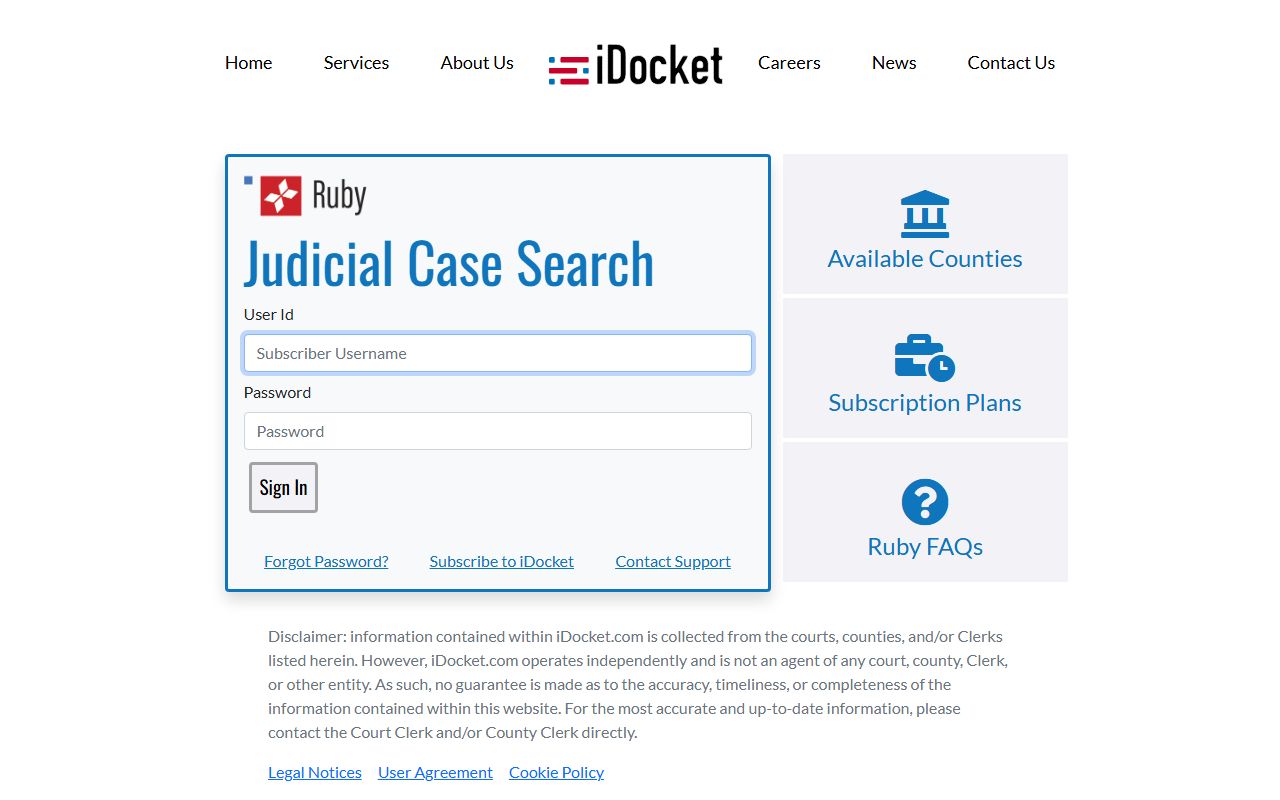
Use the portal for available case access, then confirm unclear or time-sensitive charge status with the King County clerk.
Statewide Court Records After Arrest
re:SearchTX is the statewide Texas court-records portal. It advertises case information from all Texas counties, upcoming hearings, court documents, and access for attorneys, staff, and parties. Access may vary by record type, user role, and court. It is useful when the local iDocket route does not show enough detail or when a case may have moved beyond King County's immediate clerk contact path.
Statewide access should not be read as a promise that every King County criminal filing is free, complete, or instantly available online. Court records after a jail arrest can be delayed by filing time, clerk entry, sealing rules, juvenile status, or pending litigation limits. For basic public case data, the portal may help. For certified copies, exact docket status, or missing entries, the clerk's office remains the direct source.
The re:SearchTX portal provides the broader statewide court search context for King County court records.
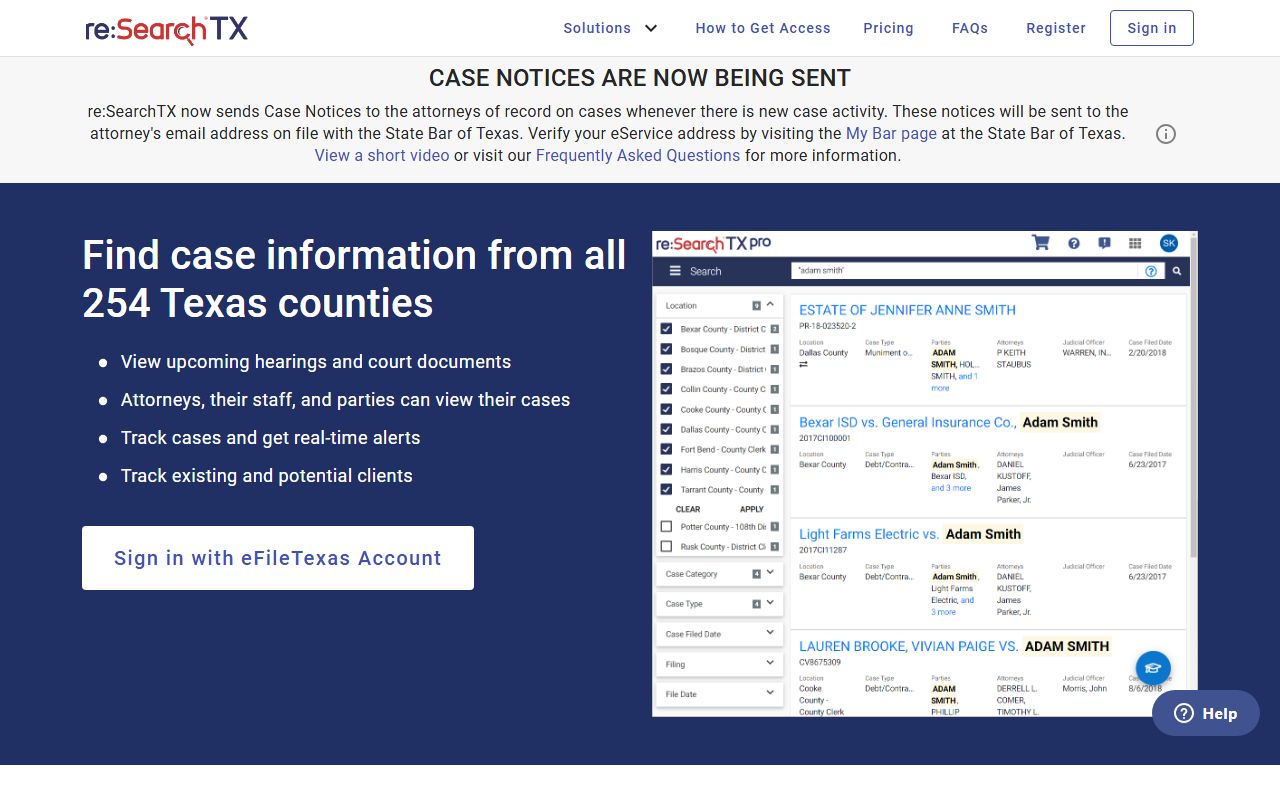
Use statewide search as a fallback, especially when the local portal is gated or the exact court is not yet clear.
Charging Documents After Arrest
A booking entry may show the reason for custody, but a court record depends on a charging document. In Texas criminal practice, the common labels include complaint, information, and indictment. The district attorney may use one path or another based on offense level and case posture. Charges can also change after review. That is why a jail charge should be checked against the filed document before it is treated as the active court charge.
| Document | Filed By | Common Use | Why It Matters |
|---|---|---|---|
| Complaint | Officer or prosecutor | Allegation or sworn basis that may start a case | Often the earliest court-side charge record after an arrest. |
| Information | Prosecutor | Many non-indictment prosecutions | Shows the charge the state is choosing to pursue. |
| Indictment | Grand jury | Felony prosecution | Shows a grand-jury charging decision and formal count language. |
King County felony-level matters are handled by the 50th District Attorney. For docket copies and case status, the research points back to the clerk and court-search systems rather than the DA office. The prosecutor's role is charging and prosecution; the clerk's role is maintaining filed court records.
King County Charge Status
Charge status is the main reason to search court records after a jail arrest instead of stopping at booking data. A charge may be pending at filing, later amended to a different offense, reduced to a lower level, dismissed by the court, or declined by the prosecutor. A warrant can add another layer, because a person may be held on a King County case, another county's warrant, a capias, or a federal or immigration hold.
| Status | What It Means | Where to Verify |
|---|---|---|
| Pending | The charge has been filed or is awaiting further court action. | Clerk, iDocket, re:SearchTX. |
| Amended or reduced | The state changed the charge wording, count, or level after review. | Filed charging document and docket entries. |
| Dismissed | The court record shows the count was ended without conviction on that charge. | Clerk disposition or signed order. |
| Declined | The prosecutor did not pursue a charge from the arrest or booking stage. | Clerk if filed; DA or records channel if no case was opened. |
| Convicted | A plea, verdict, or judgment resulted in conviction. | Clerk record and, for criminal history, TxDPS. |
No official King County active-warrant search was located, and no Garza County warrant portal was found on the sheriff page. For warrant questions, use the King County Sheriff's Office, the Justice of the Peace or clerk, iDocket, re:SearchTX, Garza County Jail if the person is housed there, and open records for non-online records. Garza's Sheriff Connect app exists as a Garza mobile channel, but no app-only warrant, roster, or mugshot feature was verified.
Charges Versus Convictions
Being arrested or charged is not the same thing as being convicted. A booking record may reflect probable cause, warrant language, or an officer's initial charge entry. A court record shows the formal charge path. A conviction record means a plea, verdict, or judgment has resolved the charge against the person. This distinction is critical when reading King County court records after an arrest, especially if the case is new or the jail record has not caught up with the court.
| Point of Comparison | Charge | Conviction |
|---|---|---|
| Meaning | An accusation or filed count. | A final result after plea, verdict, or judgment. |
| Timing | Can appear soon after arrest or filing. | Appears only after case resolution. |
| Proof Stage | Based on probable cause or prosecutor filing decision. | Requires a legal finding or plea. |
| Best source | Clerk, docket, charging document. | Clerk disposition, judgment, TxDPS criminal history. |
TxDPS Criminal History Name Search is a statewide criminal-history tool, not a jail roster and not a local court docket. It requires a secure website account and search credits. The DPS search fields include required first and last name, optional middle or maiden name, and birth-date options. Use it when the question is criminal history or conviction data, not when the need is a fresh custody check or a newly filed docket.
The TxDPS Criminal History Name Search page shows the account and credit-based path for statewide criminal-history searches.
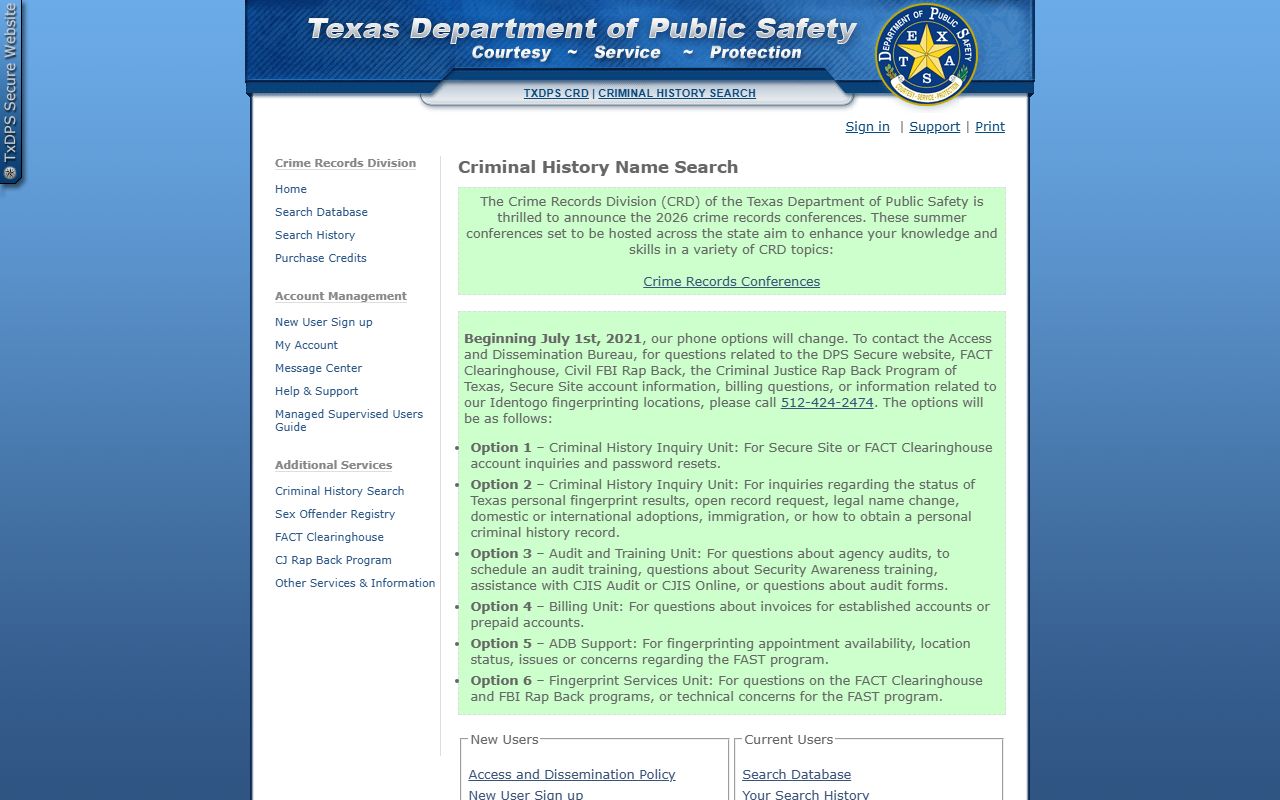
DPS can help with statewide history, but the clerk is still the better source for a specific King County docket entry.
Sealed or Expunged Arrest Records
Texas law has different paths for limiting public access to an arrest or case record. Texas Code of Criminal Procedure Chapter 55A governs expunction of criminal records in eligible cases. Expunction is not a phone request to a jail and is not the same as asking a search site to remove a record. It normally depends on a court order and the specific disposition of the case.
| Point of Comparison | Sealed | Expunged |
|---|---|---|
| Public view | Hidden from most public access if the court grants sealing or nondisclosure. | Removed or treated under the expunction order as legally cleared from public record paths. |
| Record status | May still exist for limited official use. | Covered agencies must follow the court's expunction order. |
| Typical trigger | Eligibility under nondisclosure or sealing rules. | Eligibility after dismissal, acquittal, no charge, or other qualifying outcomes under Chapter 55A. |
| Where to start | Case court and clerk. | Case court and clerk. |
Restricted records may include juvenile records, sealed cases, expunged records, protected victim information, and parts of law-enforcement files tied to active prosecution. Texas Government Code Chapter 552 gives the general public-information framework, while law-enforcement exceptions and court orders can limit what is released.
Records Requests After Arrest
When a court record is not online, contact the King County Clerk or District Clerk for filed cases. When the need is a booking record, incident record, release record, or booking photo connected to the contract jail path, Garza County's open-records form is the more specific local record channel found in the research. The form asks for incident type, date, file number if known, incident address, and involved persons with identifying details such as date of birth, age, race, and sex.
Public access point: Chapter 552 generally makes public information available unless an exception applies. Section 552.108(c) treats basic information about an arrested person, an arrest, or a crime differently from investigative details.
The Garza form says the Sheriff's Office has ten business days to process a request and may seek an Attorney General opinion instead of releasing information. Copies are listed at $1.00 per page, extra cost applies over 50 pages, estimates are sent for charges over $40, and completed requests must be picked up within 15 calendar days after notification. If a requester fails to pick up records and then asks again, fees for both requests may be due.